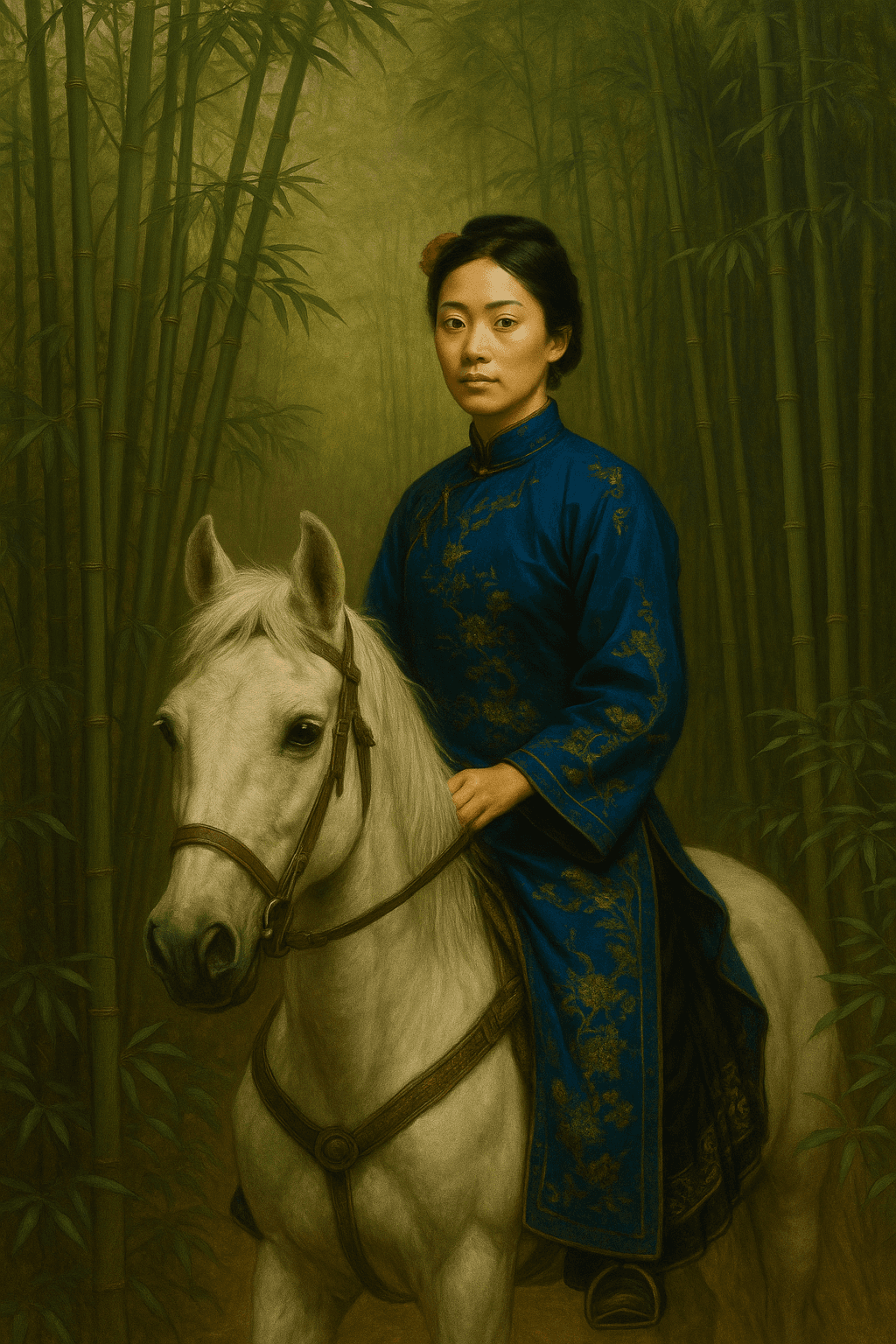
I. The Mainland Years
Liang Mei-lin was born in the spring of 1822, in a village near Guangzhou where the Pearl River bends toward the sea. Her father was a silk merchant of modest means; her mother, a woman who could read—rare enough to be dangerous. From her mother, Liang learned characters by candlelight. From her father, she learned that every transaction has a hidden cost.
By fifteen, she could calculate exchange rates faster than the men in her father's counting house. By eighteen, she had buried both parents—her father to debt collectors, her mother to grief. The house was sold. The debts remained.
II. The British Invasion
When the British warships came in 1839, Liang was working as a translator for a tea merchant in Guangzhou. She watched the iron steamers churn up the river, belching smoke like demons from a folk tale. The city fell. The treaty was signed. Hong Kong—a rocky island the Cantonese called 香港, "fragrant harbor"—was carved away and handed to the foreigners like a slice of winter melon.
Liang followed the trade, as she always had. She arrived in Hong Kong in 1842, carrying everything she owned in a single wooden chest: her mother's books, her father's abacus, and a jade pendant she would never sell, no matter how hungry the nights became.
III. The Fragrant Harbor
Hong Kong in the 1840s was a fever dream of ambition and desperation. British officers strutted through half-built streets while Cantonese laborers hauled stones for their mansions. The opium trade—the very poison that had started the war—flowed more freely than ever, now blessed by treaty and protected by gunboats.
Liang found work at the 夢煙閣—the Pavilion of Dream Smoke—an opium den that catered to military men. Her job was simple: recruit customers, keep them comfortable, ensure they returned. She learned which officers had gambling debts, which had secrets, which wept for wives back in England. Information, she discovered, was worth more than silver.
"I did not sell my body," she would later write. "I sold my silence. A more profitable trade, and one that leaves fewer bruises."
IV. James Yarrow
James Yarrow arrived in Hong Kong in the autumn of 1843. He was different from the other British traders—younger, quieter, with the look of a man running from something rather than toward it. He came to the Pavilion not for the opium but for the tea they served in the front room, and he looked at Liang the way no Englishman had before: as if she were a person rather than a fixture.
They spoke in English at first, then in fragments of Cantonese as he learned. He asked about her books. She asked about the country he had fled. Neither gave complete answers. Trust, like silk, must be woven thread by thread.
Liang told herself it was strategic—a useful connection, a man with access to shipping manifests and harbor schedules. She told herself this for months, even as she began to wait for the sound of his footsteps on the stairs, even as she started wearing the jade pendant where he might see it.
"愛情係最危險嘅債務。"
(Love is the most dangerous debt of all.)
V. Between Empires
Now, in 1843, Liang moves between two worlds that pretend the other does not exist. She takes tea with British officers' wives and mahjong with Cantonese merchants. She carries messages she does not read and keeps secrets she will never sell. She writes letters to James that she sometimes sends and sometimes burns.
She is twenty-one years old. She has survived a war, an empire, and her own heart. She does not know what comes next—only that she will face it the same way she faces everything: with sharp eyes, a sharper tongue, and the quiet certainty that no one will save her but herself.